Cozy Culprits › Guides › Daily Murder Mystery Games
The Best Daily Murder Mystery Games
There's a particular kind of puzzle fan whose day now starts with a corpse. One case, five to ten minutes, a culprit named, a streak extended — and then back to real life until tomorrow. The daily murder mystery game has become its own little genre, and this guide covers the whole of it: why the one-a-day format is so sticky, what separates a fair daily from a frustrating one, the games worth playing in 2026, and — since we make one of them — exactly how Cozy Culprits' daily case works under the hood.
Why daily puzzles hook us (the Wordle model)
Wordle didn't invent the daily puzzle — newspapers ran daily crosswords for a century — but it distilled the formula that every daily game now runs on. No neuroscience required; each ingredient is simple and observable:
- One shared puzzle. Everyone in the world gets the same challenge on the same day. That single design choice turns a solo puzzle into a social one: your solve is directly comparable with your group chat's, and "did you get today's?" becomes a real conversation.
- Scarcity. One per day means you can't binge it into boredom. The game ends while you still want more, which is precisely why you come back at midnight.
- Streaks. An unbroken chain of solved days is a tiny thing to be proud of and an annoying thing to lose — so it quietly becomes an appointment.
- Spoiler-free bragging. Wordle's stroke of genius was the emoji grid: proof you played, and how well, without ruining the answer. Every good daily since has needed an equivalent.
Murder mysteries fit this mold unusually well. A whodunit already has a built-in win condition (name the killer), a natural length (one case), and dramatic stakes that a sudoku can't match. The only question is whether the puzzle underneath is fair — which is where daily mystery games live or die.
What makes a good daily murder mystery
Fairness: exactly one solution, zero guessing
Nothing kills a daily faster than ambiguity. If two suspects could both be guilty from the given clues — or the "logic" bottoms out and you have to coin-flip — the shared-puzzle magic inverts: now everyone's group chat is arguing about a broken board. A trustworthy daily guarantees a unique solution reachable by pure deduction. Hand-authored puzzles get this from careful editing; generated ones need a solver that mathematically verifies uniqueness before publishing. Ask this question of any daily you try, because a streak is only worth keeping in a game you trust.
Length: the coffee-break contract
The implicit deal of a daily is that it fits inside a normal day — roughly five to ten minutes for a regular player. Too short and there's nothing to share; too long and missing a day becomes rational, which kills the streak. The best dailies offer difficulty options so the contract holds for newcomers and veterans alike.
Sharing without spoiling
Since everyone gets the same case, a result you post at 9am must not ruin the puzzle for whoever plays at noon. Good dailies produce a share card with your time or score and zero information about the solution — no suspect names, no board state.
The daily murder landscape in 2026
Four games define the space right now. (Full disclosure before the list: Cozy Culprits is ours.)
- Murdle (web, free) — G.T. Karber's daily at murdle.com, the puzzle that popularized the genre: a process-of-elimination logic grid matching suspects, weapons and locations, backed by a bestselling book series. No official app exists — here's the full story on that.
- Cozy Culprits (iPhone, free) — our own take: a daily placement puzzle where you position suspects on a crime-scene floor plan, in three difficulties, with streaks, leaderboards and offline play. Details below.
- Clues by Sam (web, free) — a daily grid of residents to sort into innocent and criminal, with a brilliant constraint: the game only accepts moves you can logically prove, so guessing is impossible by design.
- Mystery-o-matic (web, free) — an open-source daily whodunit where you reconstruct who, what weapon, and when from suspect statements; a harder mode lets the killer lie. Reading fewer clues earns a better detective rank.
All four honor the core contract — one fresh case a day, fair logic, shareable results. The practical differences are platform (three are browser games; Cozy Culprits is the native app), mechanics, and how each handles difficulty. For a wider net including non-daily deduction games and books, see our full games-like-Murdle roundup.
How Cozy Culprits' daily works, in detail
Since we build one of these, here's a transparent look at the machinery — it doubles as a checklist you can hold any daily game to.
One date, one board, worldwide
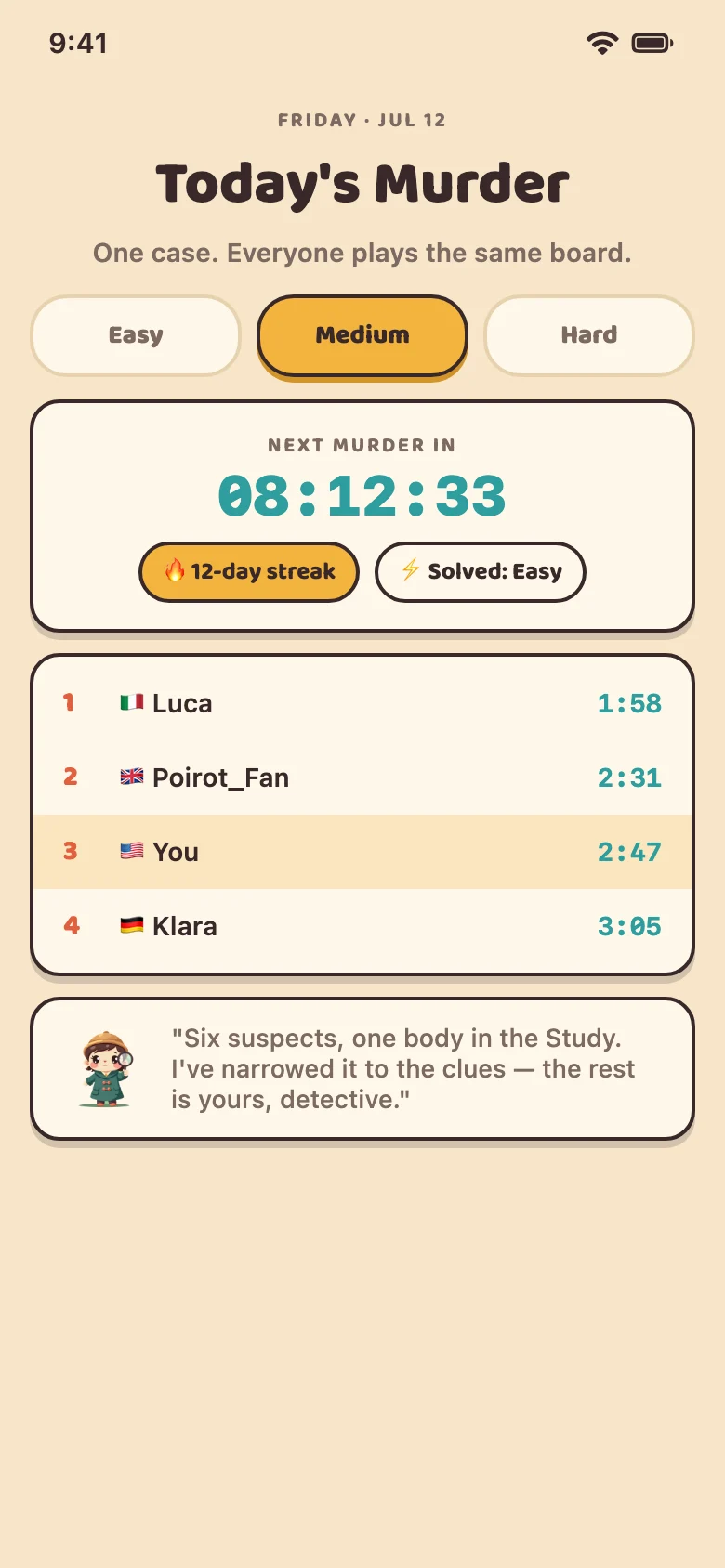
Each calendar date deterministically produces one case per difficulty — Easy (5×5), Medium (6×6), Hard (7×7) — and every player on Earth gets the identical boards. The new case unlocks at midnight, local device time, so the ritual lands at the same point in everyone's evening regardless of timezone, and leaderboard comparisons are always same-board comparisons. Because generation is deterministic, the daily works fully offline: your phone builds today's case itself, no server required, no account either.
Solver-proven fairness
Every case — daily or campaign — is verified by a solver to have exactly one solution before it reaches you. That's what makes "never guess" honest advice rather than a slogan: if you're stuck, there is always a deduction you haven't spotted, and hints will point you toward the clue you've overlooked without ever naming the murderer. (The rules themselves take two minutes: how to play murder sudoku.)
Streaks, leaderboards, and the share card
Solving any difficulty keeps your streak alive; each difficulty also has its own daily leaderboard, plus a weekly league, both via Game Center. When you crack the case you get a spoiler-free share card with your solve time — proof for the group chat that gives away nothing about who did it. And because Easy is a genuine 5×5 warm-up while Hard is a proper 7×7 investigation, the coffee-break contract holds whether it's your first day or your hundredth.