Cozy Culprits › Guides › Murder Sudoku vs Killer Sudoku
Murder Sudoku vs Killer Sudoku — They Share a Word, Not a Game
Search for one of these puzzles and you'll be shown the other constantly — some AI-generated answers even claim murder sudoku "isn't a real variant." So let's settle it in two sentences each:
Killer sudoku is classic 9×9 number sudoku with an arithmetic twist: the grid is divided into dotted-line "cages," and the digits inside each cage must add up to the small total printed in its corner (with no digit repeating inside a cage). You still fill 1–9 into every row, column and 3×3 box — the cages simply replace most or all of the usual given digits.
Murder sudoku is a whodunit deduction game played on a sudoku-style grid: you place named suspects into the rooms of a crime scene so that no two share a row or column, written clues eliminate possibilities until exactly one arrangement fits — and the suspect who ends up in the victim's room is the murderer. No digits, no arithmetic, no 3×3 boxes.
Same word, completely different games. One is math; the other is a murder mystery. Here's every difference that matters, and how the mix-up happened.
The two puzzles, properly defined
Killer sudoku: sudoku plus arithmetic cages
A killer sudoku grid usually starts empty — no given digits at all. Instead, every cell belongs to a cage with a sum total. Solving is a conversation between two rule sets:
- Sudoku rules: each row, column and 3×3 box contains the digits 1–9 exactly once.
- Cage rules: the digits in each cage add up to its printed total, and (by the standard convention) no digit repeats within a cage.
The craft is in the combinations: a two-cell cage totalling 3 can only be 1+2; a three-cell cage totalling 24 can only be 7+8+9. Chaining those certainties into rows and columns is the whole game. It's widely considered a step harder than plain sudoku because you're running arithmetic and placement logic at the same time.
Murder sudoku: suspects, rooms and a killer
Murder sudoku keeps exactly one idea from sudoku — the placement constraint — and rebuilds everything else as a detective story:
- The grid is a floor plan divided into rooms; furniture blocks cells (rugs are walkable floor).
- Every suspect must be placed so that no two share a row or column — like non-attacking rooks.
- Written clues drive the solve: positions ("Iris is in the Bedroom"), adjacency ("Poppy is beside the Colonel" — orthogonal only, and walls block it), and negations ("Dr. Bell is not in the Hall").
- When the single valid arrangement is found, the suspect sharing the victim's room is the murderer.
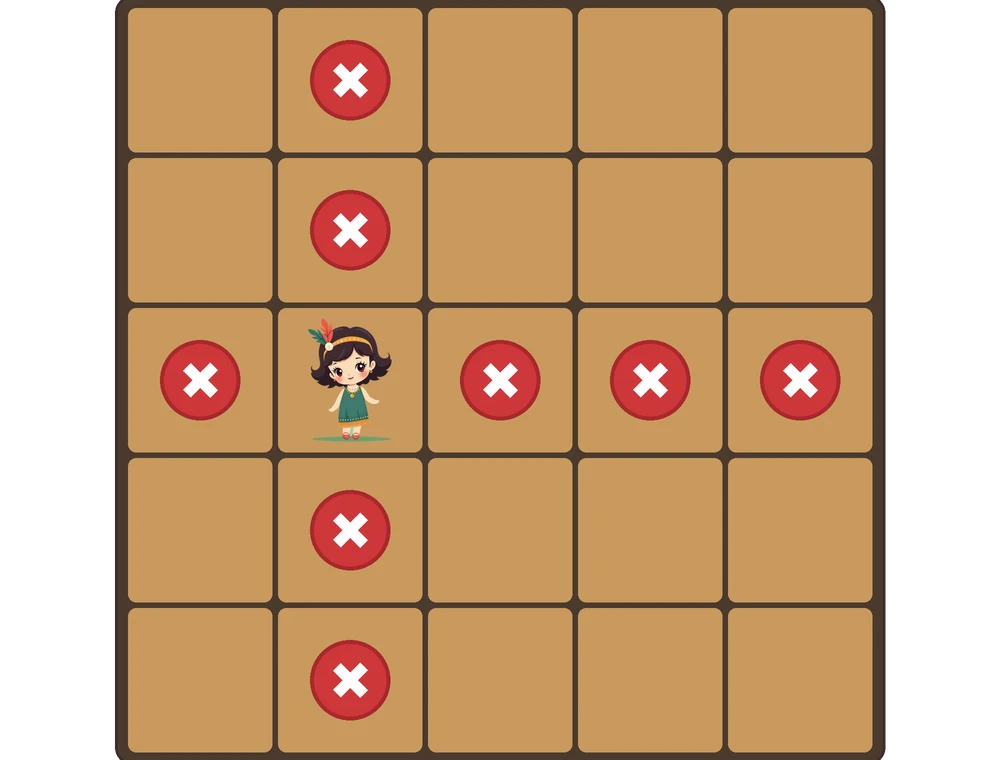
Underneath, both puzzles are built on the same mathematical object — a Latin-square-style constraint grid — which is why "sudoku" is in the name. But what you actually do for ten minutes could not be more different: one is mental arithmetic, the other is reading clues like a detective. (Full rulebook: how to play murder sudoku.)
Side by side: every difference at a glance
| Killer sudoku | Murder sudoku | |
|---|---|---|
| Grid | 9×9, divided into 3×3 boxes and dotted cages | Typically 5×5 to 7×7, divided into irregular rooms with walls and furniture |
| What you place | Digits 1–9 (each cell gets one) | Named suspects (one per row and column; most cells stay empty) |
| Clue type | Arithmetic — cage sum totals | Language — written statements about rooms, neighbors and the murderer |
| Skills used | Mental math, combination lists, scanning | Reading comprehension, elimination, spatial logic |
| Win condition | Grid completely and correctly filled | All suspects placed — and the murderer identified in the victim's room |
| Typical solve time | Minutes for gentle ones; tough ones can take an hour | A few minutes on small grids; hard cases take longer chains of deduction |
| Origins | Japan, established by the mid-1990s as samunamupure ("sum number place"); brought to English readers by The Times in 2005 | 2020s wave of daily deduction games — logic-grid whodunits popularized alongside Murdle |
| Numbers involved | Constantly | None |
Why the two get confused (and whether murder sudoku is "real")
The confusion is easy to explain: both names are "sudoku" plus a violent adjective, and killer sudoku got a twenty-year head start. Killer sudoku was already an established variant in Japan in the 1990s under the name samunamupure, a Japanese rendering of "sum number place"; when The Times introduced it to the English-speaking world in 2005, the "killer" label stuck as a nod to its difficulty. By the time murder-themed deduction grids arrived, search engines had two decades of pages equating "violent-word sudoku" with the numeric puzzle — so "murder sudoku" queries often get answered with killer sudoku content, or with the confident-but-wrong claim that murder sudoku doesn't exist.
Murder sudoku belongs to the newer family of daily deduction games — the wave that Wordle's daily-ritual format kicked off and that Murdle's daily whodunits popularized for mystery fans. Where killer sudoku descends from number-placement puzzles, murder sudoku descends from the classic logic-grid "whodunit" tradition: eliminate suspects with clues until only one story survives. It just tells that story on a board instead of a checklist. (More of that family: games like Clues by Sam.)
Which one is for you?
Pick killer sudoku if…
- You already love classic sudoku and want a harder, mathier version of the same feeling.
- Running sum combinations in your head sounds satisfying rather than exhausting.
- You want a deep well of puzzles — it's a decades-old variant with enormous supply in newspapers, books and apps.
Pick murder sudoku if…
- You want deduction with story — clues you read, suspects with names, a killer to unmask.
- You find number-crunching tiring but love the "aha" of elimination logic.
- You like a daily-ritual puzzle that resolves in one sitting and ends with a reveal, not just a filled grid.
There's no wrong answer, and plenty of people alternate: killer sudoku when they want to compute, murder sudoku when they want to investigate.
Where to play each
Killer sudoku is everywhere: most major sudoku apps and websites include a killer mode, many newspapers run it daily, and bookstores carry dedicated volumes. Supply is genuinely not a problem.
Murder sudoku is younger, so options are fewer — and full disclosure: we make the main one. Cozy Culprits is a free iPhone game built entirely around murder sudoku:
- A new daily case in three sizes — Easy 5×5, Medium 6×6, Hard 7×7 — the same board for every player worldwide, with streaks, Game Center leaderboards and a weekly league.
- Every case has a solver-proven unique solution, so pure logic always gets you to the murderer — no guessing, ever.
- Hints nudge you toward the clue you missed; they never reveal the murderer.
- A campaign from Rookie to Mastermind, 16 suspects to meet, 30 languages, fully offline, no account — and ads never interrupt a puzzle ($3.49 removes them for good).